John Cerpnjak
  • About
  • Journal
  • Portfolio
  • Contact Me
  • Call Me
  • Menu Menu

After Making Real Estate Lead Generation Websites for Over a Year Here’s What I Learned

case study, copywriting, email marketing, freelancing, seo, web design

I’m excited to follow up with all of you on my previous post about real estate lead generation, because today I’m taking a deeper look into some real estate lead generation websites I’ve worked on over the past year.

Some of the work I have to show you is from as far back as January of 2017. However, I still continue to produce marketing projects for this client to this day. I’m going to share with you some traffic campaigns, email sequences and SEO work I’ve created in the real estate marketing niche.

Basically what I am sharing with you is a case study of 18 months worth of work on building different real estate lead generation websites. To make this post easier to navigate I’ve included a table of contents with auto-scrolling links to the various sections. Enjoy!

Table of Contents

  • Niche Content Website
  • Google Adwords Campaign
  • Landing Page Headline Split Testing
  • Halton REI Microsite
  • The Secret Organic Traffic Strategy You Need for Your Real Estate Lead Generation Websites

Over the last year and a half I have been managing the marketing for serial entrepreneur, Erwin Szeto (the client), who is listed on the top 20 influencers in the world of real estate in Canada. He’s on the list with the likes of Stefan Aarnio, Scott McGillivray and the Property Brothers, Drew and Jonathan Scott. I like to think my marketing work has played some small part in propelling him to that status.

I met the client through my association with the Rock Star Inner Circle, which is a network with hundreds of small business entrepreneurs.

When I first met the client he was largely known as “Mr. Hamilton”. The client explained to me that he had positioned himself as a trusted expert on real estate investments within the Hamilton area. However, he wanted to expand his business to include more regions on the west side of the GTA, like St. Catharines and Niagara. The client had recently switched from using TopProducer to Infusionsoft for his CRM.

Also, the client was hosting his own monthly networking events for lead generation and so he was interested in running a PPC advertising campaign for the very first time to increase the attendance.

Niche Content Microsite

The first thing I got started on was a whole bunch of keyword research and SEO. I proposed creating a niche content microsite that included SEO articles targeting geographic keywords & topics with above-average click volume and low competition. The articles would be repurposed into a downloadable PDF, which would be used as a lead magnet. With the microsite being built with WordPress I would use a plugin for pop-up opt-ins. I knew all of this would make for a valuable real estate lead generation website and the client accepted my proposal.

investinstcatharines.ca

And thus, investinstcatharines.ca was conceived.

Google Ads Campaign

Again, this was the first time the client was trying paid traffic with Google. In order to meet the high expectations of pay-per-click advertising I called on my friends Thomas and David from Reverb Consulting.

I wrote and designed landing pages on the investinstcatharines.ca domain. A 3-step traffic funnel was created to generate leads for the networking event. The first page offered the lead magnet, the thank you page followed up with the networking event offer and then the final page allowed users to refer a friend to join them at the event.
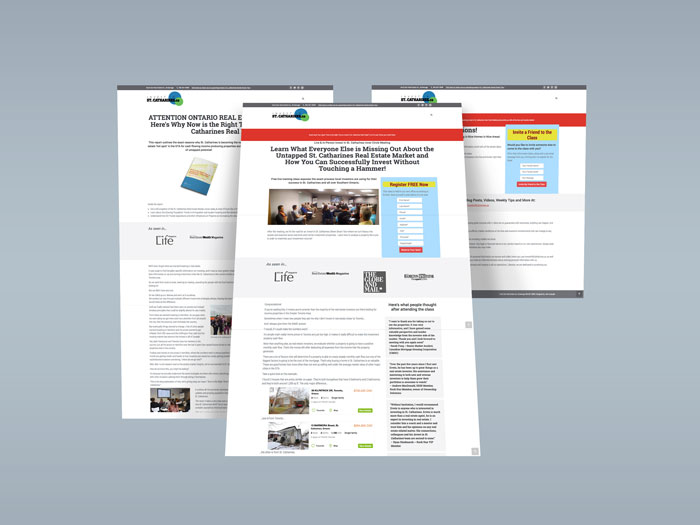
real estate lead generation

Infusionsoft Marketing Automation Campaign Builder

I incorporated marketing automation with Infusionsoft by creating various email sequences to track who received the lead magnet, who registered for the networking event, who attended and who was a no-show. Based on the tagging I could segment the leads into different groups for future marketing offerings.

email automation

THE RESULTS

Below are some highlights from the Google Ads campaign. I’m really proud of the results because our efforts lead the networking event to grow so large that another venue was required to accommodate everyone.

In just 6 months time, I grew the attendance by 292.5% from 27 people to 79 people.

You can see in these before and after pictures why we had to move the networking event to a larger space. The attendees were essentially getting squeezed like sardines inside the office meeting space in Oakville. So the networking event moved to the Sheridan College Conference Centre.

Here’s an overview of the results from the Google Ads campaign.

TOTAL SITE SESSIONS

Paid Search accounted for 26% While still accounting for over 50% of all conversions.

In the first 3 months of site launch, paid search accounted for 40% of site sessions and 82% of goal completions. Organic traffic never accounted more than 40% of total traffic.

Total Site Sessions: 4605 Unique Visitors

PAGES PER SESSION

Often with ads, (when done poorly) you will see a low number of pages per session. When people are unfamiliar with a brand and they ended up on there because of a click they are likely to bounce. This shows that our ads were targeted with appropriate copy to bring in the right people.

Pages Per Session on ads was 2.55

PAID ADS CONVERSION

Generally, the lowest conversion rate on a site will be seen by ads. It stands to reason that the people who have actually searched out your site directly would be the most likely to convert compared with those who’ve ended up there because of an ad they just saw. However, the average conversion rate for organic traffic was 1.49% with the next closest to paid ads being referrals with 6.18%. We were able to outperform both organic and referral traffic as the highest converting channel.

Paid Ads Conversion rate was 9%

OVER 242 GOAL COMPLETIONS

This is where we can look at everything that happened over the course of the campaign. As you will see paid goal conversions accounted for over 50% of the total amount. What you don’t see here is that both direct and organic have first click attribution numbers from paid. Meaning, while they eventually converted through a direct visit or an organic search, there is initial contact made with adwords:

Paid: 133
Direct: 61
Organic: 24
Referral: 24

ADWORDS SPECIFIC HIGHLIGHTS

Totals for the campaign

Total Clicks: 1739
Total Cost: $4,308.11
CPC: $2.48
Bounce Rate From Ads: 25%
Average Pages per Session: 2.56
Goal Conversion Rate: 8.69% (Average for site was 3.74%)

I’m proud to report that the client spent $4,308.11 for the advertising campaign, which grossed $14,939 in sales from leads generated during the campaign.

Split Testing Headlines

While collaborating with Reverb Consulting, we had noticed we were experiencing a drop off between people who converted on the first landing page but then did not convert on the second. This drop off was bigger than what we wanted to see. It was an indication to us that something about the second page was not connecting with visitors.

So, in the forth month of the PPC campaign we decided to set up a split test to try different headline copy ideas.

The second landing page was the one with the offer to get on the guest list for the networking event. During this time, the client’s networking event was called the St. Catharines Inner Circle Meeting.

The headline on the landing page mentioned St. Catharines by name, so we had a hunch that maybe our ad traffic was getting confused and thought the networking event was actually taking place in St. Catharines, when it actually took place in Oakville.

A lot of our click volume was coming from the Halton region, including areas like Oakville, Milton, Burlington etc. We hypothesized that our traffic wasn’t taking up the networking event offer because they believed the event was in St. Catharines and therefor to far of a commute to attend.

I decided the best way to alleviate this problem was to remove the mention of St. Catharines in the headline to see if it would improve the conversion rate.

And sure enough it worked!

Insights And Discoveries

I also want to note that the data we collected and the split testing we were doing lead us to another insight. When we first started the campaign we cast a pretty large net for geo-targeting. We were showing our Google Ads to anyone who was searching our targeted keywords across all the major cities in the GTA.

Over time we began to notice that most of the clicks on our ads were coming from wealthier cities in the GTA. Meaning that people in Hamilton, Kitchener, Waterloo, Cambridge, Guelph etc. weren’t looking for real estate investment opportunities in St. Catharines as much as people from Oakville, Mississauga and Burlington.

This lead us to switching up some of our marketing tactics going into the back half of 2017.

Halton REI Microsite

Armed with these new insights, we decided to do a quick rebrand of the networking event. The client decided to call it the Halton Real Estate Investors Meeting, or Halton REI for short.

I quickly got to work on making a new WordPress site for the Halton REI, which was great because with the expert search engine optimization work I had done for this new site, we could organically target people searching for investment property info on the westside of the GTA but who lived near Halton. We use this site to collect leads for the networking event.

real estate lead generation websites

Throughout the rest of the year we made marketing videos to promote the networking event including testimonials and reactions from the attendees. The client also has a podcast website and another website about real estate investment information in Hamilton that I managed. We even got into some retargeted Google display ads before the end of the year.

The Secret Organic Traffic Strategy You Need for Your Real Estate Lead Generation Websites

If you’re creating your own real estate lead generation websites and you’re hesitant to spend money on paid traffic advertising with Google or Facebook, this is what I would keep in mind…

Over the last year and a bit I’ve been looking back and reflecting on all the real estate lead generation websites I had done. I had figured out how to best build a website and how to target keyword content to generate qualified traffic made up of investors doing research on which cities would be good places to invest in real estate.

I had figured out how to create appropriate lead magnet content to collect subscribers and grow the client’s audience. And then I figured out how to market the networking meeting to grow the attendance each month.

If you’re a realtor looking for real estate investor clients and you’re trying to figure out your own digital marketing or website strategy I have some advice I would recommend.

First you need to pick a particular geographic area you want to position yourself as an expert. Let’s say you’re a realtor in Durham Region (east side of the GTA). You would need a website ranking for content that investors would be searching about in Durham.

Then you need to market your realtor services for those geo-locations. Create web pages about why your services are better than the competition in the cities and neighbourhoods you want to target.

When building out a website you need to be conscientious about its architecture. It’s good practise to group your content into silos; where you’re creating a ‘parent page’ that links out to ‘child pages’ within it.

For example, you could make silos like this:

  • durham real estate investing
    • durham population
    • durham economic development
    • durham real estate market
    • durham zoning bylaw
    • durham transit
  • durham real estate investor services
    • pickering real estate investor services
    • ajax real estate investor services
    • whitby real estate investor services
    • oshawa real estate investor services
    • clarington real estate investor services
    • scugog real estate investor services
    • uxbridge real estate investor services
    • brock real estate investor services

If you build out a content marketing strategy like this for your website you should notice that you probably won’t get a TON of traffic, but it will be HIGHLY QUALIFIED and most importantly it will be ORGANIC.

This means you won’t have to spend thousands and thousands in ad spend to generate real estate investor client leads like my client did. Your website should be able to do that for you all on it’s own. Just remember to always take your time and create high quality content that will build trust in your audience and position yourself as an authority.

If you found any of the information in this article useful, leave me a comment below. Feel free to follow up with me with any questions you may have.

And if you’re looking to generate real estate investor leads with your own website and would like some help or advice, then definitely reach out to me on my contact page.


2 Comments
https://i0.wp.com/cerpnjakjohn.com/wp-content/uploads/2018/08/RealEstateLeadGenerationWebsites.jpg?fit=845%2C321&ssl=1 321 845 John Cerpnjak https://cerpnjakjohn.com/wp-content/uploads/2017/06/JohnCerpnjakLogo.png John Cerpnjak2018-08-20 16:25:232018-09-25 20:49:40After Making Real Estate Lead Generation Websites for Over a Year Here’s What I Learned

If You Can Be Self-Employed, You Should!

freelancing

self-employedI want to share with you my first business breakthrough when I became self-employed.

There’s an accountant I work with who often says

“it’s not about how much you make that matters, but how much you keep”.

When I was younger I didn’t really understand what this meant. I mean, yeah, it sounds intelligent, but I figured “keeping” money was just another way of saying “spend less”.

However, after the first year I started working as a self-employed freelance digital marketer and was doing my personal tax returns, I realized that this advice was really about finding ways to reduce your taxable income.

Of course I’m talking about reducing your taxes by law abiding means and not being a crook.

The last job I had before going off on my own was working for a telecom company making a $50,000 salary.

So, when I did go off on my own, my goal was to match that and make $50,000 in the first year.

In my mind, I figured if I could make $50,000 on my own, essentially unemployed (cause you know, I wasn’t on anybody’s payroll), that it would be a great life experience. A fate far better than still sitting inside a cubicle office any longer.

And I thought even in a worse case scenario where somehow I totally screw up and lose all my money, I’d still have the experience of knowing how to make $50,000 all on my own. And nobody could ever take that experience away from me. Even if I lost it all, I’d know how to make it back because I have the experience of no longer relying solely on employment income.

So there I went off on my merry way, making strategic professional relationships, finding my own clients, doing work I’m proud of and eventually invoicing those clients and getting paid.

Inevitably I climbed past the $30,000 mark, registered my business name with the CRA (Canada Revenue Agency) and started adding HST tax to my invoices. I kept going and managed to reach that goal of $50,000 by year’s end.

Now here’s the cool part with the business breakthrough…

Everyone knows that whatever your annual salary is, you always take home less because of taxes and deductions on each of your pay cheques.

Here’s a snapshot look at what you lose if you make $50,000 a year working in the province of Ontario.

50000 salaryYou lose about $11,500, which is almost 25% of your earnings. It totally sucks, I know. But that’s the life of an employee.

However, when you’re self-employed things work a bit differently. You see, you can reduce your taxable income amount by claiming business expenses.

This is how it works, when you charge HST tax on your invoices you’re suppose to keep that money to the side and pay it to the CRA (the government). You can choose to make these HST payments annually, quarterly, monthly and I think you can even choose to pay bi-weekly. In my first year I paid it all annually at the end. Since then I’ve been doing it quarterly.

Here’s the cool thing with being self-employed, you can reduce the amount of HST tax you owe by offsetting it from the HST tax you pay on your business expenses.

So anytime you buy office supplies, computer upgrades or software, automobile expenses and gas, your phone and internet bill etc. all these things can be claimed as a business expense.

To figure out what you owe the government in taxes, you take all the HST you’ve collected from your invoices (in other words your income) and subtract it from all the HST you spent on your business expenses.

Chances are very likely that you’ll owe less taxes than someone who works as an employee.

So, what did I owe the government in taxes for that first year I was self-employed? Let me show you!

taxable income

That’s a photo of the letter my accountant wrote for me on the front page summary report of my personal income tax return for the 2016 fiscal year. I legally only owed the government $3,564.43 in taxes.

If you ask me, that’s a much sweeter deal than being an employee.

However, there are 2 caveats with this.

  1. The government forces everyone to make a CPP (Canada Pension Plan) contribution of 10% of your income. When you’re an employee you pay 5% and your employer matches the other 5%. When you’re self-employed, in the eyes of the CRA, you are both employee and employer of your own business, so they make you pay the full 10% on your own. But you don’t have to pay EI (employment insurance) deductions when you’re self-employed.
  2. Because it was the first time I had to manage all my income and expenses on my own, my accountant told me I was lousy at bookkeeping and I should have been better at keeping all my receipts. My accountant told me I could have paid even less tax if I was better at keeping track of all my expenses. (Fuck me, I guess).

So you better believe I went out and bought Freshbooks Cloud Accounting to help me with that! And guess what, my accounting software is a business expense so now I can deduct that too!

When it comes down to it, when you’re an employee making $50,000, you’ll pay roughly $11,583.60 in taxes and deductions. Compare that to the $8,564.43 (combining the HST I owed plus 10% CPP) I had to pay as a self-employed individual who made $50,000.

You can clearly see that I walked away at the end of the year with more money being self-employed. And that was my biggest business breakthrough in the first year. Now, it’s only a difference of about $3,000 and you might be thinking that’s not much. But think about all the cool stuff I can do with that extra $3,000. I can reinvest it back into my business, or put it towards retirement savings, hell, an extra $3,000 is even a good chunk of money for a vacation!

Now that I’ve learned this, I don’t think I’d go back to working for someone else as an employee. I’ve also been reading and educating myself more about small business taxation and how money works. It turns out that the small business tax rate in Canada is 15%. Compare that to the 100% tax you have to pay on every dollar you earn as an employee.

Although I haven’t incorporated my business yet to get that small business tax rate, it is my next goal to achieve. As well as continuing to increase my annual income well pass $50,000.

It does seem however, that the more I learn, the more I realize being an employee is the worst career choice you can make from a financial stand point.

Now, being an employee isn’t terrible. I started out as an employee, as do most other people. It’s a great way to get into the labour market and to get on-the-job experience in your field. But remaining an employee for the entirety of your career, well, that’s probably not the best choice you could be making for yourself (or your family). Although, every individual is different and I don’t want to come across as someone with a self-employed bias…

…but if you were to ask me what’s the moral of this story?

Simple: if you can be self-employed, you should!

0 Comments
https://i0.wp.com/cerpnjakjohn.com/wp-content/uploads/2017/08/Self-Employed.jpg?fit=1000%2C750&ssl=1 750 1000 John Cerpnjak https://cerpnjakjohn.com/wp-content/uploads/2017/06/JohnCerpnjakLogo.png John Cerpnjak2017-08-22 16:24:362017-08-22 20:23:59If You Can Be Self-Employed, You Should!

The Importance of an Interdisciplinary Approach to Multimedia and Business

freelancing, work philosophy

multimediaIt’s been said that every entrepreneur is a digital entrepreneur.

And in a sense all entrepreneurs are using digital technologies to build, launch, and grow their businesses.

But it would be wrong to think all entrepreneurs are doing everything digitally.

Although, amazingly, it is now possible to do that.

And it can create compelling career and lifestyle options for you in the process.

But what exactly is a digital entrepreneur and how do you become one?

Well in a word: interdisciplinary skills.

I know, that’s two words.

But anyone with multimedia skills, which are interdisciplinary in nature, can become a digital entrepreneur.

Digital entrepreneurs are business owners who focused exclusively on digital commerce.

And digital commerce is selling products and services that are marketed, delivered, and supported completely online.

Examples of digital commerce products include ebooks, online education, membership sites, downloadable software or files, web hosting and web site management, and software as a service (“SaaS”).

Anyone with multimedia skills like web/app design, photography, videography and writing can build a business for themselves.


What does every multimedia expert and digital entrepreneur need to succeed?

It stands to reason a good website is a prerequisite for success.

There are five elements of the modern marketing website that all multimedia specialists need to be thinking about and implementing in a smart way.

Really, all entrepreneurs need a website that incorporates these five elements.

  1. Email (registration, not just opt-in)
  2. Adaptive content and responsive design
  3. The access experience
  4. Online courses as lead magnets
  5. Testing … of everything

Technical skills in multimedia is what you’ll need to implement those 5 elements for yourself. And an interdisciplinary approach will help you execute the work.

A podcast I listen to from the people over at CopyBlogger discus these five elements in the second episode. Here’s a quick link incase you want to listen: The 5 Elements of the Modern Marketing Website

How many people does it take to build an effective website?

You know, I frequently find myself having this conversation with potential clients often.

It honestly doesn’t take that much to develop an effective online marketing solution.

I’m living proof you can do it as one person.

In the multimedia field there are three primary areas of expertise involved with creating an effective website:

  • art/design
  • technical
  • marketing

Sadly many schools offering web design programs don’t offer a comprehensive curriculum which adequately addresses all these areas.  Most schools focus primarily on the design aspect (layouts, colors, etc.)  By necessity they do delve into the technical side, but tend not to spend significant time teaching students about search engine optimization and the more technical aspects of developing a website.  And many schools tend to spend even less time teaching basic marketing principals.

This was a major struggle for me when I first graduated from McMaster University and Humber College and entered my career. I felt like my technical skills were well-rounded but I knew I didn’t know how to apply them in a way that someone would offer me a job for money.

It wasn’t until I met these 2 brothers who co-owned their own business and who were super smart marketers, that I started to understand how to take my understand of web design (and a bunch of other multimedia practices) and really create a web site so that it functioned as a primary marketing vehicle for business.

That’s really why I started writing and journaling the experiences I’ve had working for myself.

If I can play any part in sharing even a small nugget of knowledge or information that could help another young person find their way into a multimedia and digital entrepreneurial career path… I’ve won!

So listen, I’ve got a lot of ideas about what I’d like to write about but I’d still like to hear what you think. You can either write to me on my contact page or leave a comment at the end of this post. I’ll share case studies of my work, the strategies I use to find clients and process & techniques I use to make my various multimedia and digital marketing work.

And if you’re feeling really awesome you can join my email newsletter. (Maybe I’ll even show you how I make graphical HTML email templates).


0 Comments
https://i0.wp.com/cerpnjakjohn.com/wp-content/uploads/2017/07/InterdisciplinarySkillsFeature.jpg?fit=760%2C570&ssl=1 570 760 John Cerpnjak https://cerpnjakjohn.com/wp-content/uploads/2017/06/JohnCerpnjakLogo.png John Cerpnjak2017-07-21 00:20:372018-04-24 17:53:12The Importance of an Interdisciplinary Approach to Multimedia and Business

4 Skills You Need to Quit Your Job and Go at it Alone

career skills, entrepreneur, freelancing

Hello Planet Earth,

If you’re like most people, you’re probably content with your 9-5 job. Getting up in the morning, putting on some fresh office threads and getting through your drive time commute are all things you’ve probably grown familiar and comfortable with.

Your job performance is probably spot-on, whatever your duties may be, and you probably feel secure with your bi-weekly pay cheques. It’s probably a good life you live.

Or is it?

If you’re anything like me, you can probably remember a time back in grade 10 Careers class when the teacher asked you some pretty common questions like, “what do you want to do when you grow up?” or “what kind of hours do you want to work?” and the often asked, “what are you most passionate about?”

I remember all the students in the class being split into little groups where we’d huddle together and share some thoughts and ideas. Back then when I was 15, I remember a lot of the students fantasized about being ‘entrepreneurs’ or ‘freelancers’.

We didn’t really know what those words meant back then because most kids’ parents were the typical 9-5 corporate office workers.

But the allure of being your own boss peaked the interest of every 15 year old, even though none of us had mentors at the time to guide us towards any kind of self-made success.

I mean, what high school teacher would know anything about being self-employed… or any university/college professor for that matter?

I personally didn’t meet any entrepreneurs who would take me under their wing and show me the ropes of how to make a job for myself, instead of trying to find a job like everyone else.

I’m 26 now and have been working in my career for the last 3 years and at the end of last month I did something crazy…

… I quit my job working in the marketing department of a telecom company without any other job offers from another employer.

You see I didn’t need any other job prospects. Over the last 3 years, I spent my evenings and weekends doing various different types of copywriting and design freelance work for a handful of ongoing clients.

I got to a point where my freelance work was presenting more interesting opportunities for my career than my regular day job. Quitting my 9-5 to free up more time for the more interesting freelance work was a no-brainer.

So now I’m going to share with you the 4 skills I developed over the course of my career so far that’s allowed me to quit my corporate job and take on the world on my own terms!

Learn Copywriting

Let me start by saying this: when I was in university I realized that all the wealthy and successful people I knew, the people making 6-figures or more, were all terrific communicators. Whether it was with writing or speaking, they could all communicate clear and concise thoughts and ideas. The kind of ideas that are worth being sold and ultimately worth good money in return.

Copywriting is the craft of writing persuasively with the intention to sell. Because of that little insight I realized in university, I went on to study Advertising Copywriting in a 1-year post-grad college program.

You don’t have to go to school to get an education in copywriting, but I firmly believe having copywriting as one of your skill sets to be an invaluable tool. The better you can write, the more money you’ll be able to make.

There are some great resources online if you wanna improve your copywriting skills. Copyblogger has a membership site, it’s free to sign up, and you’ll find a ton of great informational resources from them. Everything from articles about headline writing, email subject lines, to how-to guides for writing you own books and reports.

With strong writing and communication skills, it’ll help improve and amplify the other skills listed below.

Learn Design

Once you’ve got a piece of writing put together the next thing you’d need to figure out is how you’re going to layout your copy on a print document, webpage, banner sign etc.

You don’t need to be an award-winning designer to get work for yourself.

Just having a solid foundational understanding of layout compositions, colour theory and typography are enough. If can use Photoshop, Illustrator and Indesign you’ll have the tools to solve any design problem.

Kuler can help you decide on colour swatches for your design projects.

TypeEd is a wicked resource for learning everything about typography. I recommend signing up to their email newsletter as they share different tips on typesetting and typographic design.

Learn Code

Learning computer programming languages was something I tried avoiding whenever I could when I was in university and it’s something I regret doing while growing up.

Since I started my career it’s become more and more clear to me how valuable learning to code is not only useful now, but will continue to be useful in the future.

Again, you don’t need to be a master at web development or programming, but a solid understanding of HTML and CSS will give you the ability to build websites, landing pages, and graphical emails. All of which are projects business owners will pay good money for.

Codeacedmey is a great place to learn how to write code online. It’s a membership site and when you create an account you can take their online courses for free.

HTML5up is another resource you can download free creative commons licensed website templates from.

If you’re going to be doing work on the web in this digital information age we now live in, it’s also a good idea to wrap your head around content management systems (CMS) like WordPress. Something like 25% of all websites on the internet are built on the WordPress platform.

WordPress runs on a PHP framework, so having even a beginners understanding of PHP can help you become more useful to prospective clients. There’s other langaues you can learn like JavaScript and JQuery, but you don’t really have too.

My own knowledge of PHP, JavaScript and JQuery are pretty limited but it hasn’t stopped me from creating work for myself.

Be a Cool Cat

What I mean by this is people have to like you. The clients you’re going to do work for need to trust you and have faith you can deliver on what you promise.

You need to adopt a style and tone of professionalism. This doesn’t mean you necessarily have to dress in suits, just don’t dress like a trucker.

You also need to pay attention to the way you speak. There is a lot of jargon when it comes to copywriting and design. Heck, some business people might not even know that when you’re using the word “copy” that you’re taking about the written words on an advertisement or web page!

It’s important to learn to speak to people in a way that they’ll be able to understand you.

Know this, if you’re talking to someone and they don’t understand the design or web development terminology you’re using, it’s not their fault for not knowing. It’s your fault for not communicating in a way that they can understand you simply.

Design is about taking complex ideas and communicating them in the most simple and effective manner possible. You need to embody this principle not only in your work, but in the way you interact with others.

I was having lunch with one of my clients the other week along the Toronto harbor front. We were just making small talk over some beer when he started to compliment the way I dress and the way I speak. He told me that I gave him the strong impression that I was a young professional who was hungry for success, and that he was happy he fired his last freelance contractor and found me instead. This particular client was a successful middle-aged real estate renovation specialist, so it was cool that he could see these things in me.

I’m not saying you should be fishing for compliments during your client meetings, but you need to understand that people will want to work with you for reasons beyond the actual sit-down-computer-work you do for them.

Quitting your job and working for yourself requires that you build and nurture your own professional contacts. People work with people they like, so if you can be a “cool cat”, people will see you as a subject matter expert and a trusted advisor.

There you have it! Those are the 4 skills I developed over the course of my school education and early career that helped me quit my 9-5 job and take on the world alone; copywriting, design, coding, and being a cool cat (professional communication skills).

Are you a freelancer or entrepreneur? What skills do you have that you believe are vital to your success? Leave a comment below and let me know what you think.

Until next time…

Keep rockin’ in the free world!


0 Comments
https://cerpnjakjohn.com/wp-content/uploads/2017/06/JohnCerpnjakLogo.png 0 0 John Cerpnjak https://cerpnjakjohn.com/wp-content/uploads/2017/06/JohnCerpnjakLogo.png John Cerpnjak2016-08-15 20:03:182016-08-24 00:26:404 Skills You Need to Quit Your Job and Go at it Alone

Join My List

Read These

  • AIDA Copywriting: Definition, Examples, and StrategiesApril 21, 2021 - 12:33 am
  • real estate lead generation websites
    After Making Real Estate Lead Generation Websites for Over a Year Here’s What I LearnedAugust 20, 2018 - 4:25 pm
  • seo pr strategy
    Stumbling into My Own SEO PR Strategy by AccidentJuly 31, 2018 - 6:46 pm
  • “Do We Need to Switch to a New SEO Plugin?”May 17, 2018 - 9:00 am
  • gradient background
    Gradient BackgroundFebruary 20, 2018 - 9:35 pm

Follow Me

Instagram

Follow Me!

What I can do for you

  • Copywriting Services
  • Performance Marketing Services

Explore

  • About
  • Contact
  • Journal
  • Portfolio

Contact

John Cerpnjak
Cerpnjak Consulting
50 Ordnance St

Toronto, ON M6K 0C9, Canada
905-330-9535
talk@cerpnjakjohn.com

© Copyright - John Cerpnjak
  • Link to X
  • Link to Facebook
  • Link to Instagram
  • Link to Youtube
  • Link to LinkedIn
  • Privacy Policy
  • Cookie Policy
Scroll to top Scroll to top Scroll to top
John Cerpnjak
Manage Your Consent

To create the best user experience possible, I use technologies like cookies to store or access your device's information. Consenting to these technologies allows me to get a sense of your browsing behaviour. Not consenting or withdrawing consent, may adversely affect certain features and functions of my site.

Functional Always active
The technical storage or access is strictly necessary for the legitimate purpose of enabling the use of a specific service explicitly requested by the subscriber or user, or for the sole purpose of carrying out the transmission of a communication over an electronic communications network.
Preferences
The technical storage or access is necessary for the legitimate purpose of storing preferences that are not requested by the subscriber or user.
Statistics
The technical storage or access that is used exclusively for statistical purposes. The technical storage or access that is used exclusively for anonymous statistical purposes. Without a subpoena, voluntary compliance on the part of your Internet Service Provider, or additional records from a third party, information stored or retrieved for this purpose alone cannot usually be used to identify you.
Marketing
The technical storage or access is required to create user profiles to send advertising, or to track the user on a website or across several websites for similar marketing purposes.
  • Manage options
  • Manage services
  • Manage {vendor_count} vendors
  • Read more about these purposes
View preferences
  • {title}
  • {title}
  • {title}

Loading Comments...